
HAWTHORNE DOWNS
A Short Story by Chad Schomber

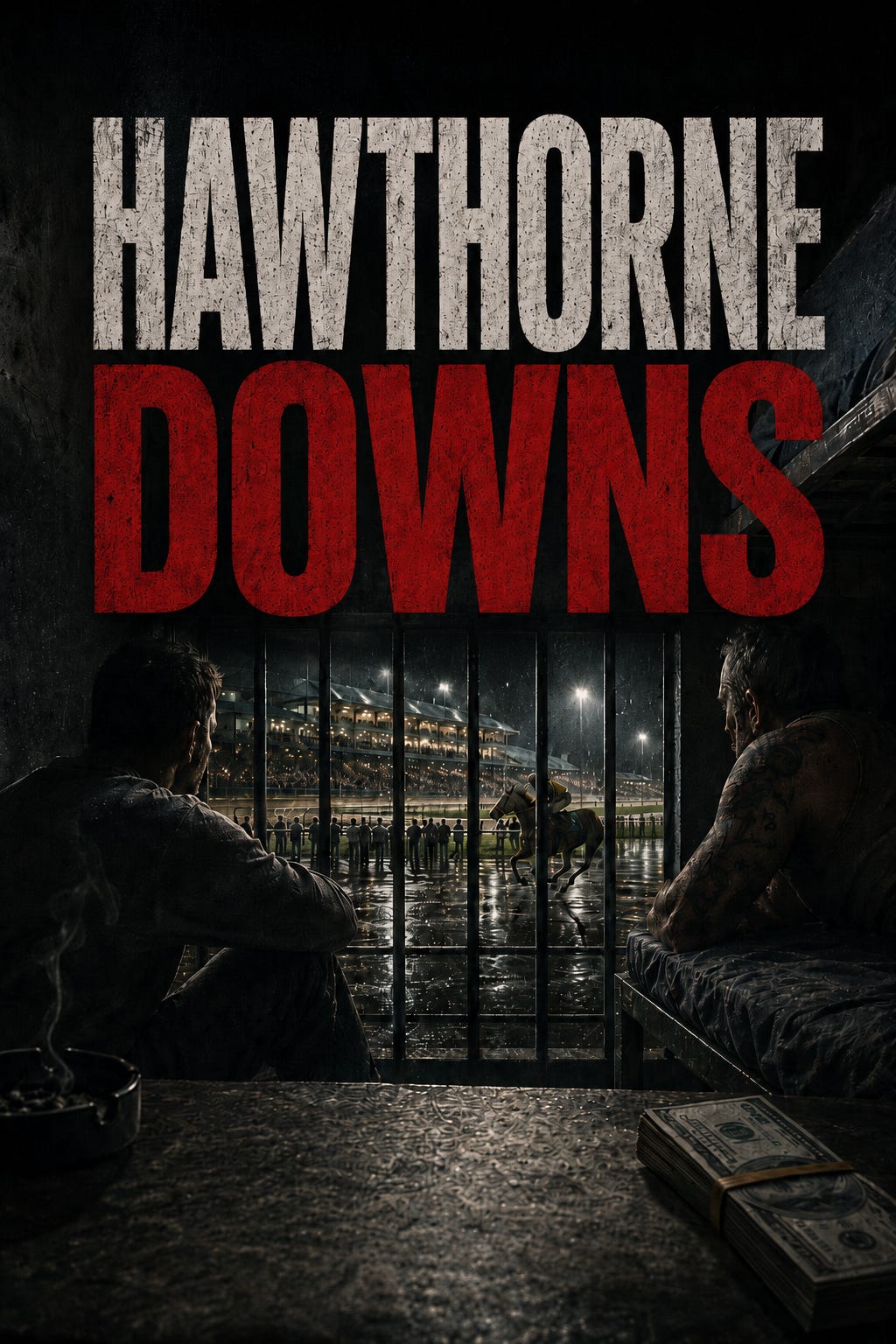
The first thing Satch ever told Penn about Hawthorne Downs was that money.
“Smelled like metal,” he said from the bottom bunk. “Like if rain could rot, you know?”
Penn laughed the first time he heard it.
Three months later he was lying awake in the dark listening to Satch explain the same racetrack for maybe the hundredth time while heat sweated out of the prison walls.
The cell smelled like bleach, mildew, cigarettes, and men.
Somewhere down the tier somebody hacked up a lung every thirty seconds. Pipes knocked inside concrete. The noise of routine muttered through bars far away.
Satch kept talking through all of it.
“You ever hold racetrack money? After winning a trifecta?” he asked.
Penn stared at the underside of the top bunk.
“No.”
“It ain’t casino money. Casino money’s hard. Sharp. Comes through machines. Racetrack money’s is soft like woman’s breast. Warm. Feels just right in your hands, you know?”
Penn said nothing.
Below him a contraband lighter clicked.
Orange light flashed briefly under the blanket.
“Every bill’s been wrinkled in somebody’s fist,” Satch said. “People lose grocery money at tracks. Mortgage money. Child-support money.”
Penn checked the glowing hands of the watch hidden in his mattress seam.
2:11.
“You done?” he muttered.
“Nope.”
Smoke drifted upward.
“The best part is the booze truck.”
Penn rolled onto his side despite himself.
There it was again.
The hook.
Satch knew exactly when curiosity outweighed exhaustion.
“What booze truck?”
“Delivery every Thursday. Cases for the clubhouse. Whiskey, beer, vodka.” Satch paused. “Security watches cash. Nobody watches liquor.”
Penn smirked.
“So your master plan is stealing booze?”
“No.” Satch’s voice sharpened. “Use the booze.”
Penn waited.
“You hit the clubhouse during the ninth race,” Satch said, “half the guards are staring at monitors and the other half are watching horses.”
“You already said this.”
“Because you still ain’t listening.”
Penn closed his eyes.
Days inside were dead things.
Count times. Chow lines. Fights over phones.
But nights — that’s when the bars seem to disappear.
Satch built places with his voice.
Floodlights glowing through rain.
Women screaming at horses.
Bartenders pouring whiskey while gamblers prayed through losing tickets.
Penn had never been to a racetrack in his life.
Now he could see Hawthorne Downs clearer than his childhood home.
“How much money?” he asked quietly.
Satch laughed beneath him.
That laugh again.
Like he’d been waiting all day.
“Now you’re asking the right questions.”
The first time Penn noticed Grady listening, the guard was pretending to read a magazine.
Late count.
Tier quiet except for televisions from the commons leaking blue light through bars.
Satch sat on the floor beneath the bunk using ketchup packets from chow as visual aids.
“Casinos expect professionals,” he explained. “Tracks expect drunks.”
Penn leaned against the wall.
“You’ve explained this six times.”
“Because you keep not understanding it.”
“I understand it. I think it’s stupid.”
Satch pointed a ketchup packet at him.
Penn noticed movement outside the bars.
Grady.
Magazine open in one hand.
Eyes lowered too carefully.
Listening.
Penn stopped talking immediately.
Satch noticed half a second later.
That tiny pause told Penn everything. He saw it too.
Grady slowly turned a page.
“What happened?” he asked casually. “Conversation dry up?”
Nobody answered.
Grady nodded like he expected that.
“My uncle lost two houses betting horses,” he said.
The air tightened.
Satch leaned back against the wall.
“Sounds like your uncle was stupid.”
“Most gamblers are.”
Grady looked up finally.
His eyes moved lazily between them.
“But tracks still make a hell of a lotta cash.”
Then he smiled.
Not friendly. Interested.
And kept walking.
After that, Grady started lingering.
Not enough to report. Just enough to poison the air.
He stopped shaking down their cell during searches.
Ignored cigarette smoke.
Once he slipped Penn an extra apple during chow without saying a word.
Nothing in prison was free.
Penn told Satch they needed to stop talking.
Satch waved him off.
“He’s fishing.”
“So?”
“So guards fish all day. Gives them something to do.”
Penn lowered his voice.
“Think he heard us?”
Satch looked up from his cards.
“He heard.”
Penn stared at him.
“You’re not worried?”
“I been around cops my whole life.” Satch shrugged. “Most of them are bored bastards.”
“You trust him?”
“No.”
“Then why keep talking?”
Satch smiled faintly.
“Because now he’s curious.”
“That’s bad.”
“No,” Satch said. “Curiosity’s useful.”
Penn hated when Satch talked like that.
Like every bad situation was secretly an opportunity.
Like danger was just another form of leverage.
Two weeks later Grady stopped Penn outside laundry.
“Walker.”
Penn turned slowly.
Grady leaned against the wall sipping coffee from a stained thermos.
“You ever actually been to Hawthorne Downs?”
Penn felt cold immediately.
He kept his face blank.
“No.”
“Shame.” Grady sipped again. “Good ribs in the clubhouse.”
Penn said nothing.
Grady studied him.
“You know what I like about horse people?” he asked.
Penn shrugged.
“They still carry cash.”
Then Grady walked away.
That night Penn told Satch they were done.
“No more track talk.”
Satch sat on the lower bunk sharpening a plastic toothbrush into a point with makeshift sandpaper.
“He say something specific?”
“He knows the name.”
“That ain’t nothing.”
Satch kept sanding.
Tiny scraping sounds filled the cell.
“You know why prison drives men crazy?” he asked.
Penn rubbed his face.
“Jesus Christ.”
“Because eventually fantasy becomes more real than memory.” Satch looked up. “You think I care about Hawthorne Downs because of money?”
“Yeah, of course.”
“No.” Satch smiled faintly. “I care because it’s outside.”
Penn stared at him.
For once Satch looked old. Not prison old. Actual old.
Gray stubble. Veins in his neck. Thin wrists.
A man shrinking year by year inside concrete.
“You really think you’re getting out?” Penn asked quietly.
Satch didn’t answer.
Penn didn’t push. He knew he hit a nerve.
The violence came three days later.
Penn returned from the yard and found their mattress on the floor and blood smeared across the sink.
Satch sat on the bunk holding a towel to his mouth.
“What happened?”
Satch spit red into the toilet.
“Nothing.”
Penn looked around.
The cell had been searched hard.
Books ripped apart.
Mattress seams opened.
“Grady?”
Satch nodded once.
“He came in askin’ questions.”
“What questions?”
“How much money. Who drives. Whether we’d need weapons.”
Penn stared.
“He thinks it’s real.”
Satch laughed painfully.
“Everything real in prison if you think about it long enough.”
Penn lowered his voice.
“What’d you tell him?”
“That he ain’t invited.”
“You’re playing games with a guard.”
“No.” Satch adjusted the towel. “I’m recruiting.”
Penn looked at him like he was insane.
Satch pointed upward.
“You know what prison really is?”
Penn didn’t answer.
“A warehouse for trapped men.” Satch smiled through blood. “Difference between inmates and guards is mostly uniform.”
After that, Grady stopped pretending.
He’d pause outside the bars at night listening openly.
Sometimes he asked questions.
“How many cameras?”
“How many exits?”
“What about state police response?”
Like three men discussing football.
Penn stopped participating entirely.
Satch didn’t.
The fantasy grew teeth.
They talked schedules.
Race calendars.
Delivery trucks.
Blind spots.
Penn began hating himself for noticing flaws in the plan.
For correcting details automatically.
For imagining routes.
The robbery had infected him.
Some nights he lay awake imagining floodlights over wet asphalt.
Cash bags stacked inside a counting room.
The smell of whiskey and rain and dirt.
Outside the cell the prison breathed and rattled around them like an old machine.
Inside, Hawthorne Downs became more real every night.
One evening Grady slipped into the cell during count.
Illegal.
Dangerous.
He shut the bars quietly behind him.
Penn sat upright immediately.
Satch barely reacted.
Grady looked around the cramped concrete box.
“Cozy.”
“What do you want?” Penn asked.
Grady ignored him.
He looked at Satch.
“You left out payroll.”
Penn’s stomach dropped.
Satch smiled slightly.
“Took you long enough.”
Grady crouched near the bunk.
“Derby weekend,” he said. “That kinda place clears what? Half a million?”
“Closer to eight big ones,” Satch replied.
Penn stared at both of them.
Like watching lunatics discuss weather.
Grady rubbed his jaw.
“You’d need uniforms.”
Satch nodded.
“Delivery jackets.”
“Inside man?”
“Not if timing’s right.”
Penn finally snapped.
“This is insane.”
Both men looked at him.
“You’re a correctional officer,” Penn told Grady. “You hear yourself?”
Grady laughed softly.
“You know how much they pay me to babysit animals in here?”
“That doesn’t mean—”
“My daughter needs surgery.”
Silence.
Grady looked exhausted suddenly.
Older than Penn remembered.
“Insurance ain’t covering enough,” he said quietly. “So yeah. I hear myself.”
Satch watched him carefully.
Not sympathetic.
Evaluating.
Like a horse trader.
“You got gambling debts too?” Satch asked.
Grady’s eyes narrowed.
“That your business?”
“It is if we’re talking partners.”
Penn looked between them and realized something horrifying:
they all believed it now.
The next month passed like a fever.
The prison narrowed around the secret.
Penn started seeing suspicion everywhere.
Every glance.
Every search.
Every delayed count.
Meanwhile the heist conversations became cleaner.
Sharper.
No more fantasy.
Operations.
Timing.
Masks.
Routes.
Grady smuggled in a folded map one night.
Satch spread it across the bunk like sacred scripture.
“There,” he said, tapping the clubhouse entrance. “Crowd bottleneck.”
Grady nodded.
“State patrol sits here after major races.”
Penn sat apart from them.
Watching.
Listening.
Drowning slowly.
Because some part of him wanted it.
The idea of becoming somebody else somewhere under open sky.
Prison hollowed men out.
The robbery filled the hollow space.
Then Grady cornered Penn alone.
Laundry corridor. Right where there were no cameras.
“You’re smart,” Grady said quietly.
Penn kept folding sheets.
“Lucky me.”
“You know Satch ain’t getting out, right?”
Penn stopped moving.
“What?”
Grady leaned against the wall.
“He lied to you.”
Penn stared at him.
“His parole hearing got buried years ago. He dies in here.”
The corridor suddenly felt airless.
“You’re lying.”
“No reason to.”
Penn shook his head.
“No.”
Grady watched him carefully.
Penn felt sick.
“Bullshit.”
“Maybe.” Grady shrugged. “But ask yourself something.”
Penn said nothing.
“Why’s he teaching you every detail?”
That night Penn confronted him.
The tier lights glowed dim blue through bars.
Satch sat reading an ancient paperback missing its cover.
“You never getting out?” Penn asked.
Satch kept reading.
Penn stepped closer.
“Look at me.”
Slowly, Satch lowered the book.
Neither man spoke for several seconds.
“Probably not,” Satch admitted.
Penn felt anger rise instantly.
“You lying old bastard.”
“I never lied.”
“You let me believe—”
“You wanted to believe.”
Penn grabbed the bars hard enough to hurt his hands.
“All this bullshit—”
“Ain’t bullshit.”
“You’re not even going.”
“No.” Satch’s voice stayed calm. “Maybe you are.”
Penn turned toward him slowly.
And there it was.
The truth sitting between them.
Satch stood carefully.
Old bones cracking softly.
“You know what prison really kills?” he asked.
Penn didn’t answer.
“Future.”
Satch stepped closer.
“So men make new ones. Fake ones. Violent ones. Doesn’t matter.” He tapped his temple. “You need someplace for your mind to go.”
Penn looked away. He knew Satch was right.
He had started seeing the robbery when he closed his eyes at night.
The track.
Floodlights.
Rain.
Cash.
Movement.
Freedom.
Satch smiled faintly.
“Y’think I care whether it happens or not?”
Penn swallowed hard.
“You should.”
“No.” Satch sat back down slowly. “I just wanted somebody else to carry it awhile.”
Silence filled the cell.
Outside, metal doors slammed somewhere deep in the prison.
Eight months later Penn drove west on Route 30 beneath a gray autumn sky.
Fresh out.
Cheap clothes.
Forty-three dollars.
The world felt too large now.
Gas stations.
Open fields.
People walking freely without appreciating it.
He drove with the window cracked letting cold air hit his face.
Then he saw the billboard.
HAWTHORNE DOWNS
FALL DERBY THIS SATURDAY
Penn stared at it as he passed.
His pulse quickened instantly.
Like hearing an old song.
He kept driving.
Five miles later he hit the exit ramp brakes without consciously deciding to.
The car rolled down toward distant floodlights rising against the darkening sky.
Penn gripped the steering wheel.
Somewhere in his head Satch’s voice returned smooth as cigarette smoke.
You hit people when they’re distracted by wanting something.
Penn drove on toward the track while evening settled over the highway like a closing door.