
Human Weather
A Story Starter by Chad Schomber

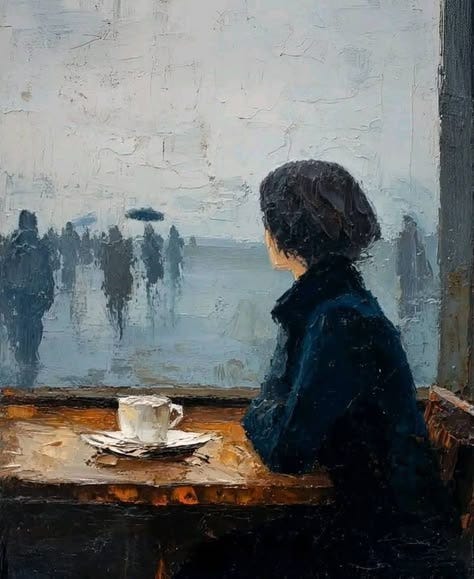
Image collected by Be Budding via Pinterest
The man at the counter had been working the same crossword for forty minutes.
He filled in artery with confidence. Left seven-down blank. Kept stirring cold coffee with a bent spoon like the answer might float up for him.
Rain pressed against the windows in gray sheets. Outside, people moved through it with their shoulders up, heads down. Nobody walked anymore. They advanced. Like the weather had them by the collar.
The woman at the front window had been there longer than him.
She sat alone at a two-top with a latte cup gone untouched except for one lipstick mark near the rim. Dark coat. Dark hair pinned loose at the neck. Young. Maybe thirty. Maybe younger.
She kept watching the street.
Not casually either. She watched it the way people watched hospital doors.
The waiter came by her table.
“Anything else?”
She shook her head without looking at him.
The waiter hesitated a beat then moved to next table.
At the counter, the man folded his newspaper smaller.
He told himself he wasn’t staring.
He came into this café every Thursday around three because his apartment felt too quiet in the afternoons. The café had steam noise, cups clinking, little bursts of conversation. Human weather. Enough to make a man feel temporarily attached to the world.
His name was Arthur, sixty-eight, retired locksmith.
His wife had been dead eleven months.
Some days he still caught himself turning to say things to her.
Look at this guy’s hat.
That song again.
We should leave before the dinner crowd.
Then nothing.
The silence afterward always landed harder because he’d heard her voice first.
The woman at the window checked her watch.
A small movement. Fast. Nervous.
Arthur looked toward the door.
Nobody.
Back to her.
She reached into her coat pocket and unfolded a piece of paper. She read it again. She folded it back along the same lines with care.
A note. A letter, maybe.
Rainwater crawled down the glass beside her face.
The café radio played Billie Holiday low enough to disappear under the blurry ambience.
Arthur looked back at his crossword.
Seven-down.
Regret. Six letters.
He almost laughed.
The bell over the door jingled.
A man entered carrying a wet umbrella and enough cold air to turn heads. Mid-forties. Beard going gray. Camel coat.
The woman stiffened.
“There you are,” Arthur thought.
The man spotted her and stopped for half a second.
Then he crossed the room.
Arthur pretended to read.
“You came,” the man said.
The woman looked out the window. “You sounded desperate.”
He sat slowly across from her. He kept the umbrella angled away from the table, careful not to drip on her coat.
“You look good,” he said.
She said nothing.
He nodded once like he deserved that.
The waiter appeared from nowhere.
“Coffee?”
“Black,” the man said.
The waiter left.
Neither spoke for a moment.
Outside, a bus rolled past in the rain haze.
Arthur watched the reflection in the window more than the people themselves. Easier that way. Less obvious.
The man rubbed his hands together.
“She knows,” he said.
The woman finally looked at him.
Arthur felt something tighten in the air between them.
“Your wife knows?” she asked.
“Yes.”
She said nothing and turned back towards the window.
“She found the letters.”
The woman smiled a little then. A tired, this is just great smile.
“You kept them?”
“I couldn’t throw them away.”
“You’re stupid.”
“I know but —.”
The coffee arrived.
The man thanked the waiter automatically. Good manners despite the catastrophe.
Arthur liked that.The ability to maintain composure during emotional chaos.
The woman leaned back in her chair.
“So what now?”
“She wants a divorce.”
“And you came here for what, comfort?”
“I came because I didn’t know where else to go.”
The woman laughed once under her breath.
Arthur looked down at the crossword again to give them privacy he knew he wasn’t actually giving.
He thought about his wife cleaning mushrooms at the sink. Her bracelets sliding down her wrist. The way she’d say his name when he forgot to lock the back door at night.
Thirty-nine years together and the arguments disappeared first. Then the voice. Then pieces of her face around the edges.
People said grief came in waves.
Arthur thought it strikes like lightning bolts.
At the window table, the man lowered his voice.
“I loved you.”
The woman stared at him a long time, head cocked.
“Loved?”
“I still do.”
“That’s worse.”
He blinked.
She picked up the cup finally, drank without reacting to the cold, flat taste.
“You should go home,” she said.
“I can’t.”
“Yes, you can.”
“She hates me.”
The woman leaned closer then. Quiet. Sharp.
“She should.”
That landed.
Arthur saw it physically. The man’s shoulders shifted like he’d been hit in the chest.
“You think I don’t know that?” he asked.
“I think you liked having both lives.”
Rain hammered harder against the windows, as if on cue.
Nobody in the café talked loud anymore. Afternoon crowds faded into eavesdropping silence without admitting it.
The man looked down at his untouched coffee.
“I was going to leave her.”
The woman rolled her eyes.
“There it is.”
“It’s true.”
“Men always say that after they get caught.”
Arthur looked at the spoon in his cup.
Twenty-three years ago he almost left his wife.
Nobody knew that.
There’d been a bartender named Elaine with red nails and a laugh that made bad decisions sound reasonable. Arthur spent three months standing too close to disaster.
Then one night he came home and found his wife asleep on the couch with the television flickering blue across her face. One hand still holding a book she’d been trying to read while waiting up for him.
That was it.
Nothing dramatic.No speech. No revelation.
He just saw the life he’d already built.
He called Elaine the next day and never went back to the bar.
Sometimes morality came down to timing.
The woman at the window unfolded the paper again and slid it across the table.
The man stared at it.
Arthur couldn’t see the words. Just handwriting.
“You remember this?” she asked.
The man nodded slowly.
“My God.”
“You wrote it three years ago.”
“I know.”
“You said if I waited, you’d leave her.”
The man closed his eyes.
Arthur looked away this time for real.
The café door opened again. Two college kids entered laughing, soaked from rain, bringing noise with them. The spell in the room loosened.
When Arthur looked back, the woman had tears in her eyes but she wasn’t crying. She looked angry that tears had shown up at all.
“I wasted years on you,” she said.
“I know.”
“You missed whole seasons. Then you’d appear with flowers and apologies and disappear again.”
“I loved you.”
“You loved hiding.”
The man flinched. That one found bone.
Outside, headlights smeared across wet pavement.
Arthur realized his coffee was empty. He considered leaving. He should leave. This wasn’t his business.
But loneliness made voyeurs out of people.
The woman stood.
The man looked panicked.
“Wait.”
“No.”
“Please.”
She reached for her coat.
“I came today because I wanted to see whether I felt anything anymore.”
“And?”
She looked at him a long moment.
Arthur thought, this is it. Here comes the knife.
Instead she said, very calmly, “I’m tired.”
That was worse.
She put money on the table for the untouched coffee and turned toward the door.
The man stayed seated.
“Claire.”
Arthur had heard her first name.
She stopped but didn’t turn around.
“You were the love of my life,” the man said.
The café went completely still.
Even the waiter froze near the pastry case.
Claire rested one hand on the door handle.
Then she said, “You should’ve acted like it.”
She walked out into the rain.
Gone fast. Her coat swallowed by gray streets and umbrellas and traffic mist.
The bell over the door gave one last weak jingle.
The man sat there alone.
Arthur knew that look too.
A person remaining after the future leaves.
The man covered his eyes with one hand.
Nobody moved toward him.
After a minute, Arthur folded his crossword and stood. His knees cracked loud enough to announce his age to the whole room.
He walked past the table.
Stopped.
The man looked up.
Arthur surprised himself by speaking.
“You should go home to your wife.”
The man stared at him, confused.
Arthur shrugged inside his coat.
“If she’s still talking to you, there’s time.”
Then he headed for the register before the man could answer.
Outside, the rain had softened.
Arthur paused under the awning and looked down the block.
The young woman was already gone. Just crowds now. Dark coats moving through steam rising from subway grates.
A city full of people arriving too late to each other.
Arthur put up his collar and started walking home.
This has been another Story Starter. If you liked it, please consider becoming a paid subscriber for more content just for you.
Totally compelling! And so satisfying. Thank you -what a gift you have.
This was such a great description - I remember how that felt in the first years of widowhood…
“He came into this café every Thursday around three because his apartment felt too quiet in the afternoons. The café had steam noise, cups clinking, little bursts of conversation. Human weather. Enough to make a man feel temporarily attached to the world.” Beautifully expressed.
You had me at the setting, and I pulled up a chair because I had to find out. Happy I stayed for a coffee! Great read.