
Silas
A Story Starter

Prologue
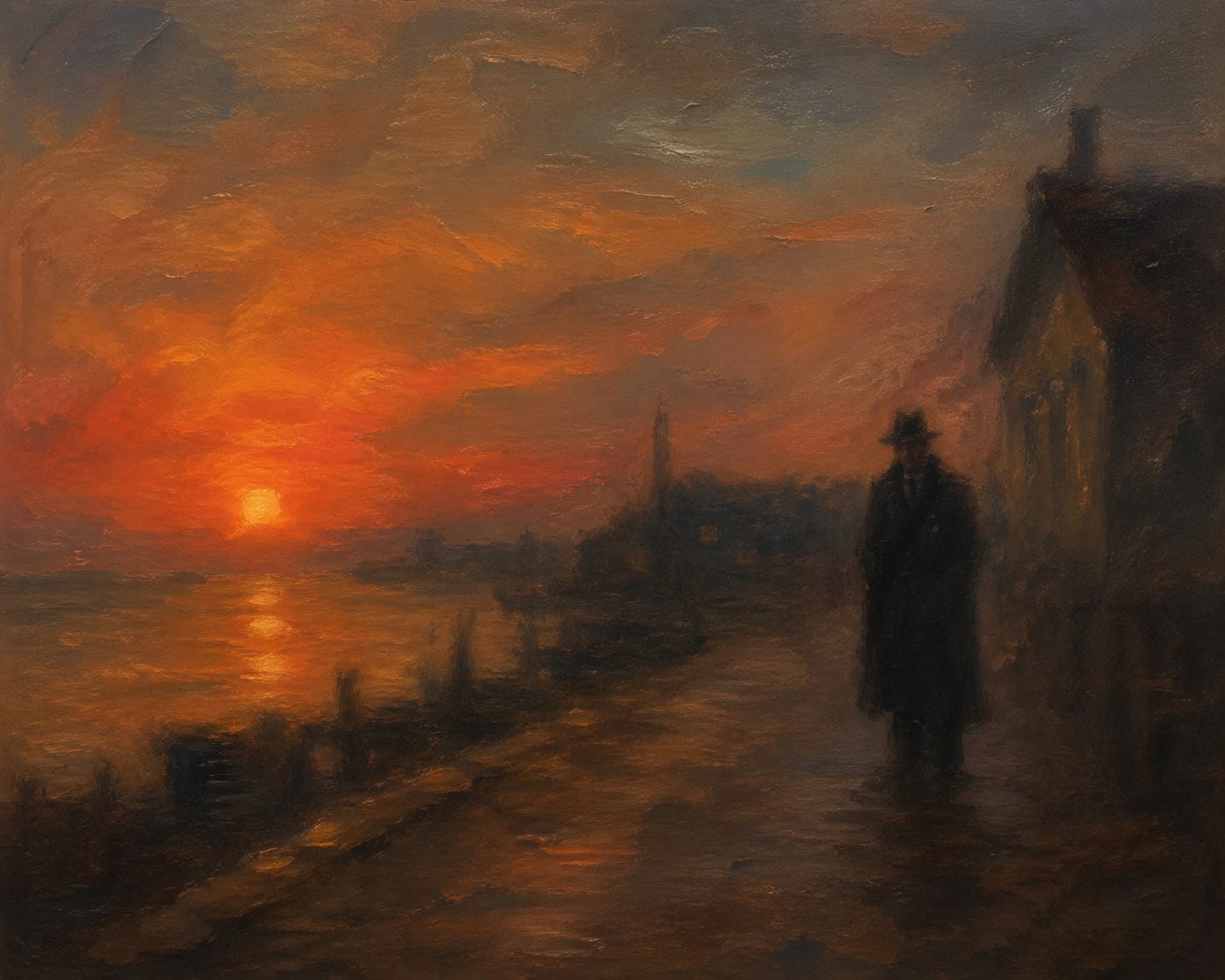
By sunset, Bellwether had begun locking itself away.
The town did it as if caution were just another evening chore. Shopkeepers turned their signs. Fishermen dragged nets from the harbor and coiled them on the docks. Mothers called children in from the seawall. Lamps appeared in the windows one by one, yellow against the bruised glass of evening.
A man in the dark coat watched from the road above town.
Nobody saw him arrive. One moment the cliff road was empty. The next, he stood where the road bent toward the harbor, his shape long and still against the burning sky.
He had no luggage. His coat was too formal for a fishing town and too old for the year. A black hat shaded his face. The wind moved around him without touching him, as if he was directing.
His name was Silas Vale.
At least for now.
The name mattered because Maren had known it. She had spoken it once in a ruined chapel with smoke in the air and blood drying beneath his collar. She had said it softly, as though naming him made him less damned.
For a while, he had believed her.
That had been a mistake.
Bellwether sat along a curled stretch of coast where the land seemed reluctant to meet the sea. The houses leaned into the wind. The docks sagged under salt and weather. A church steeple rose above the rooftops, its clock stopped at twelve minutes past four, though the bell still rang when it pleased.
Silas started down the road.
The sun had lowered to a red coin at the edge of the water. Its light struck the harbor and turned the sea to copper. He kept close to the buildings where the shadows were longest.
Sunlight did not destroy him. People had always given the sun too much credit. It hurt him, certainly. It made his skin feverish and filled his bones with a clean, punishing ache, like being remembered by God. Death was never so convenient.
Dusk suited him.
Dusk belonged to things that could not settle into one world.
A boy on a bicycle coasted past the fish market and slowed to stare. He was eleven, perhaps twelve, with a scraped knee and a face still soft with childhood. His eyes moved over Silas’s coat, his hat, his hands.
Silas smiled.
The boy pedaled hard enough to make the chain skip.
At the bottom of the hill, Bellwether opened into the harbor. Boats knocked against their slips. Men shouted in short bursts while gulls shrieked overhead. A brown dog stepped from an alley, sniffed the air, tucked its tail, and vanished beneath a cart.
Then Silas smelled lavender.
He stopped.
It was faint, almost buried beneath the tar, salt, wet rope, fish blood, and coal smoke. But it was there. Thin as a needle under the skin.
Maren had worn lavender oil because she said it calmed the nerves. When she became what he was, she kept the habit because he had begged her to remain herself in every way she could.
Silas crossed toward an inn with blue shutters and a sign that swung above the door.
THE WIDOW’S LANTERN.
The sign moved though the air had gone still.
Inside, the room smelled of fried haddock, beer, lamp oil, and damp wool. Six people sat scattered at tables. A fire burned low in the hearth. Behind the bar, a woman polished a glass with a white cloth. She looked to be in her fifties, broad-shouldered, gray-haired, with eyes that had long ago lost patience with charm.
Conversation thinned when Silas stepped inside.
The room tried to explain him. Traveler. Gentleman. Widower. Sick man.
Every person in that room had already felt the pressure behind the eyes, the chill under the tongue, the old animal warning that lived in human blood from the first nights around fire.
Silas removed his hat.
The woman behind the bar kept polishing the glass.
“Room?” she asked.
“Later.”
His voice was soft. The accent had been worn smooth by centuries, but traces remained from places that had changed names, kings, and gods.
“Kitchen’s closing.”
“I’m not hungry.”
That made the woman look at him more closely.
“Then what do you want?”
“I’m looking for someone.”
Her expression flattened.
“People who come through here usually are.”
“A woman.”
She gave a short snort. “Well, that helps.”
“Her name is Maren Harrow.”
The glass stopped moving.
It was a small thing. A breath interrupted halfway through its work. But Silas had built a long life on small things. The hand reaching under a pillow. The heartbeat changing behind a locked door. The priest gripping a crucifix before deciding whether to be brave.
The woman knew the name.
“Maren who?” she asked.
“Harrow.”
One of the men at the back table shifted. His boot scraped the floor. Another lifted his cup, then set it down without drinking.
Silas heard all of it.
The woman placed the glass on the bar.
“Nobody by that name here.”
“Perhaps not now.”
“Ever.”
“Careful,” Silas said. “That is a large word.”
Her jaw tightened. “You should leave before dark.”
Silas glanced toward the window. Outside, the last of the sun had become a red smear over the water.
“Is that local advice?”
“Good advice.”
“For men like me?”
“For anyone with sense.”
A chair scraped behind him.
The man who stood was large in the way of harbor men, with hands made thick by rope and cold water. His face was flushed with drink. He smelled of tobacco, sweat, and the first sour turn of courage.
“You heard her,” the man said.
Silas did not turn around.
“I did.”
“Then take the road.”
“I will. After she answers me.”
The man stepped closer. The room held itself still.
Silas looked only at the woman.
“Where is Maren buried?”
The color left her face.
The large man reached for Silas’s shoulder.
Silas caught his wrist without looking.
For those watching, it must have seemed gentle at first. Almost polite. Silas’s pale fingers closed around the man’s wrist, and the anger vanished from the man’s face as if someone had wiped it clean. His mouth opened. Air came out in a thin, broken thread.
The bones did not snap. Silas had no need to snap them.
Pain, properly used, was more persuasive than injury.
The man sank back into the chair he had left. His hand trembled against his chest.
Silas released him.
“Please,” Silas said to the woman.
That word frightened her more than the violence had.
She leaned closer and lowered her voice.
“Old cemetery. North of the chapel.”
“Thank you.”
“It won’t help.”
“Why?”
The woman swallowed. Her eyes flicked toward the harbor.
“Because she doesn’t stay buried.”
Silas stared at her.
For several seconds, he forgot to imitate breathing.
Outside, the church bell began to ring. Once. Twice. On the third strike, the sound broke into a dull metallic choke and rolled across the harbor like something dying in its sleep.
The woman crossed herself.
Silas put on his hat and left.
Night had settled over Bellwether, thick and blue. The lamps along the harbor glowed weakly through the mist. Water slapped against the pilings below the docks. Somewhere a shutter banged once, then closed for good.
Silas walked north.
The chapel stood beyond the last row of houses, its stones blackened by weather, its graveyard crowded beneath leaning trees. A low iron fence ran around the cemetery. The gate hung crooked on one hinge.
He stopped outside and read what names he could.
Harrow appeared on three stones.
Edmund Harrow, beloved father.
Jane Harrow, beloved wife.
A small marker for a child whose first name had vanished.
Maren was not among them.
The lavender scent drifted past him, stronger now, braided with something colder.
Sea water.
Old blood.
Silas turned from the cemetery.
The scent led him down a footpath behind the chapel, through dune grass and over stones bleached pale by the moon. Below, the old pier reached into the water like a broken finger. Half its railing had fallen away. The planks were silver with rot. A rusted chain hung across the entrance, less a warning than a memory of one.
Silas stepped over it.
The boards complained under his boots.
He had crossed battlefields with less dread than he felt on that pier.
The sea below moved black and heavy. The tide was going out, pulling long strands of weed from the posts. A loose rope dragged in the water, tightening, slackening, tightening again.
At the far end of the pier, something pale knocked softly against a piling.
Silas stopped.
For one foolish second, he let it be driftwood.
Then the tide pulled back.
A human hand had caught there, tangled in rope and kelp. Severed clean at the wrist. The skin was gray-white. The fingers curled inward as if still trying to hold something that had already been taken.
Silas crouched.
On the third finger was a ring.
Silver band. Black stone. A thin crack across its face.
The world narrowed.
He knew that ring.
He had placed it on Maren’s hand in a roofless chapel while artillery flashed beyond the hills and the priest sobbed through the vows. Maren had kissed him after, then pressed her forehead to his and whispered that eternity sounded less frightening when spoken in borrowed light.
Silas reached for the hand.
The moment his fingers touched the ring, the sea beneath the pier went still.
Every sound withdrew.
The gulls. The water. The town. The wind.
Then a woman began to sing in the fog.
Her voice came from beyond the pier, or beneath it, or from inside the old wood itself. Soft. Low. Familiar enough to wound him before he understood the tune.
Silas closed his hand around the ring.
“Maren.”
The singing stopped.
The fog gathered at the end of the pier.
A shape moved inside it.
Silas stood slowly.
He had imagined this moment for longer than most countries lasted. In those imaginings, she ran to him. She cursed him. She forgave him. She drove a stake through his heart and wept while she did it.
The shape came closer.
A woman stepped from the fog.
She wore a gray dress darkened by seawater. Her hair hung loose over one shoulder. Her face was hidden by shadow, but Silas knew the angle of her head. He knew the long line of her throat. He knew the way she held her left hand slightly curled, as if even after death she still expected to feel the weight of a ring.
“Maren,” he said again.
The woman lifted her face.
It was hers.
Almost.
The eyes were wrong.
Maren’s eyes had been brown.
These were black from lid to lid, glossy and depthless, like stones pulled from the bottom of the sea.
Silas felt the first true fear he had known in centuries.
The woman smiled with Maren’s mouth.
From beneath the pier came the wet sound of many hands gripping wood.
Then the thing wearing his lost love’s face spoke in her voice.
“Run.”
This has been another Story Starter. An idea with the bones of story that hasn’t been fully developed yet. Consider giving me a follow for more Story Starters. Better yet, become part of the team as a paid subscriber — the only way to see if these ‘starters’ become full-fledged stories.
“Like being remembered by God” is such a killer line.
Also love that the horror here isn’t really the vampire mythology, it’s longing. The whole piece feels soaked in grief, saltwater, and unfinished love. Very cool. Thanks for sharing.
You’re a very talented writer! I was fully in it, wondering what would unfold with each next line of the story. I like your story starter concept and I’m excited to read more.