
Spare couple bucks?
An opening scene by Chad Schomber

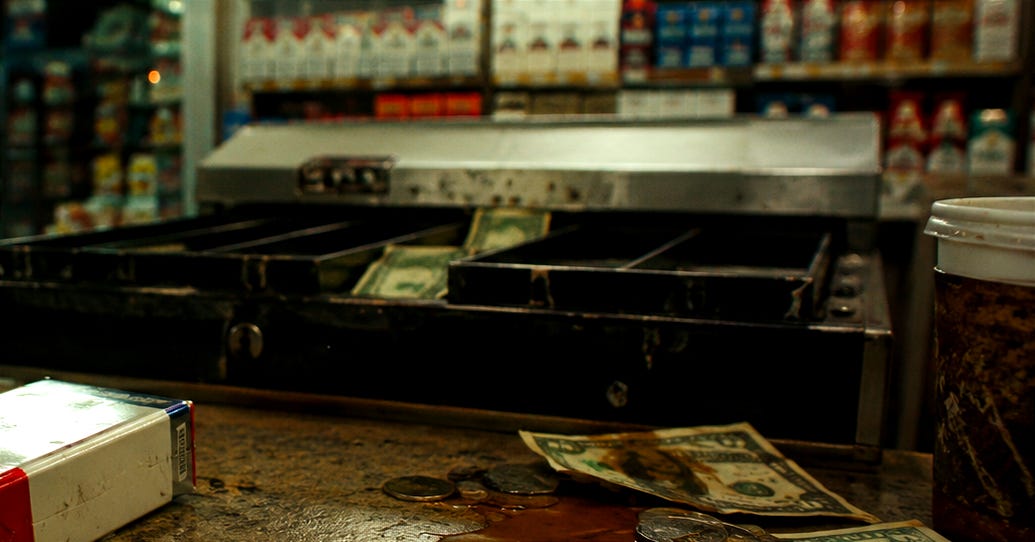
The man outside Ray’s Stop-N-Go had a beard full of weather. And a grocery bag tied around one shoe.
He worked the door in slow pieces.
“Spare couple bucks?”
The woman in scrubs kept walking.
“Ma’am?”
She didn’t look back.
A kid in a Falcons jacket came out with two bottles of Dew under one arm and Swiss Cake Rolls in his hand. The man bent toward him a little.
“Help me out, brother.”
The kid said, “I ain’t your brother.”
Inside, the clerk watched through glass fogged at the edges by fried-food steam and the February cold.
The clerk’s name was Arlen Teague. Forty-six. Bad knees. Two ex-wives. One daughter who called on Sundays when she remembered. He wore a red vest with RAY’S stitched over the pocket though there was no Ray anymore. Ray had sold the place to a Korean family in ’89 and moved to Pensacola, where Arlen figured he was either dead or carting around on some golf course.
The homeless man had been hanging around since 6pm.
Arlen had told him once, through the cracked door, “You can ask, but don’t block the entrance.”
The man had nodded.
“Yes, sir.”
Too polite, Arlen thought.Then the thought was gone.
Now the man stood under the beer sign, blue light flashing over his face every few seconds. BUD DRY. WHY ASK WHY. His cardboard sign said VET NEED FOOD. The lettering was careful. Straight lines. Good block letters, if anyone cared to notice.
A brown Buick rolled up to pump three and sat there with its lights on.
Arlen looked at the clock above the cigarette rack.
8:16.
He took the burnt coffee pot off the warmer and poured it into the sink. The smell climbed up mean and black. He rinsed the pot, set it back, looked outside again.
The man by the door had stopped asking.
He was looking at the clock too.
Arlen felt something go thin in his chest.
The Buick driver got out, a woman with big hair and a fake fur coat, mad she had to get out of the warm car. She jammed the nozzle into her car and stared at the numbers. The homeless man stepped away from the door to let her pass if she came in.
She didn’t.
Arlen reached under the counter and put his hand on the little wooden bat he kept beside the rolled pennies. Souvenir bat from a Braves game. His daughter had been seven. She’d eaten cotton candy until she got sick in the parking lot. His first wife said he’d spoiled the child.
The bell over the door gave its tired little jingle.
The homeless man came in fast.
The grocery bag was gone from his shoe.
He had a shotgun under his coat, cut short enough to swing without catching the candy rack. Arlen saw the barrel first, then both hands on it, steady, and the beard no longer looked homeless. It looked glued to a face that had been waiting.
Arlen said, “Hey—”
The shot filled the store.
The sound knocked the fluorescent lights into a pop! Then a sizzle buzz. A jar of pickled eggs jumped on the counter and rolled against the register. Somewhere behind Arlen, cigarettes spilled from the shelf in soft white bricks.
The man stepped over the place where Arlen had fallen.
He didn’t hurry now.
The cash drawer was still shut. He hit NO SALE with two fingers like he’d worked a register before. The drawer kicked out and he took the bills, leaving coins and checks and a food stamp coupon under the tray.
Outside, the woman at pump three looked through the window.
The man looked back.
She dropped the nozzle. Gas clicked on the concrete.
He reached behind the clerk’s counter and scanned the cigarette rack.
Marlboro. Salem. Kool. Winston. Camel.
His finger moved once, stopped.
He took one pack of Lucky Strikes.
One.
Then he bent close to Arlen, close enough that the old clerk could smell cold air and wet wool.
“Nothing personal,” the man said.
Arlen’s eyes had fixed on the little Braves bat under the counter.
The man put the cigarettes in his coat pocket, stepped through the bell’s weak jingle, and walked past the woman in the fake fur.
She stood there with the gas running at her feet.
Across the street, in the pay phone booth beside the laundromat, a man in a tan overcoat hung up the receiver.
He checked his watch.
8:18.
Then he smiled and crossed Rayburn Avenue toward the store.
Gritty, hard-hitting and brutal.
I like it.