
The Fence Line
A Short Story by Chad Schomber

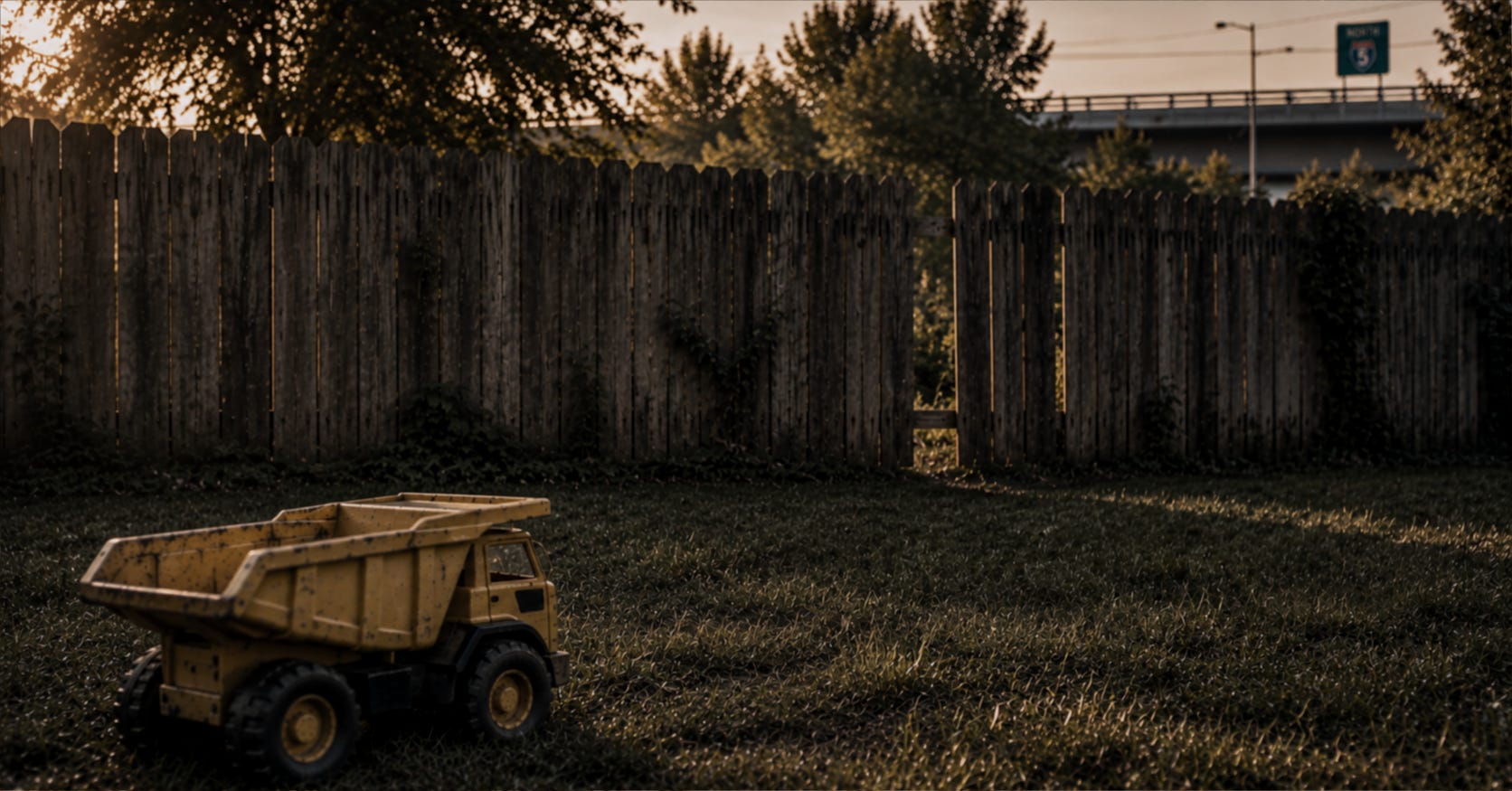
The documentary begins with a place that would be easy to overlook.
The backyard occupies a narrow strip of land behind a row of duplexes built along the edge of a freeway corridor. It isn’t especially large and even in the oldest photographs it appears neglected. The grass grows wildly, clumpy. A chain-link gate leans like it’s trying to get away. Along one side of the yard, somebody attempted a vegetable garden that never expanded beyond a few tomato plants and a patch of stubborn weeds. What distinguishes the property isn’t its appearance but its location. Beyond the rear fence lies a drainage ditch, a line of trees, and six lanes of traffic moving almost continuously throughout the day.
The freeway never disappears from the story.
In interviews, former residents describe learning to tune it out. After a few months, they say, the noise became part of the environment, no more remarkable than wind or distant birds. Yet nearly every witness mentions it. The traffic formed a kind of backdrop to daily life. Conversations paused for truck horns. Children learned to sleep through engine brakes. People measured time by rush hours.
The event at the center of this documentary took place on an August afternoon. County weather records indicate the temperature reached 93ºF. Official crash reports place a traffic accident on the freeway at approximately 3:17pm. Those details are easy to verify. The difficulty begins when the investigation moves beyond them.
Ordinary days leave poor records.
People do not document routine afternoons with the expectation that someone might revisit them years later. They remember fragments. A conversation. A smell. The shirt someone happened to be wearing. Often they remember details that seem meaningless while forgetting details that later appear essential.
This became especially apparent when the filmmakers began interviewing Caroline Mercer.
At the time of the crash, Caroline was thirty-four years old and lived two units away from the backyard where a toddler named William spent much of that summer playing. By all accounts she was a reliable witness in the conventional sense. She maintained steady employment. She had no history of legal trouble. Neighbors described her as observant, though several also used words such as reserved and private. One former resident recalled that Caroline seemed to notice things other people walked past.
That tendency may explain why she became the center of the investigation.
Years later, when asked to reconstruct the afternoon of the crash, Caroline struggled with surprisingly basic details. In one interview she remembered sitting beneath the shade of a garage overhang. In another she believed she had been standing near the fence. A third version involved watering tomato plants. The contradictions were small, but they accumulated.
What never changed was her memory of William.
The child was two years old at the time. Family photographs show blond hair, blue sandals, and a plastic dump truck that appears. Caroline remembered him playing in the dirt near the back of the yard while adults moved in and out of the heat.
She also remembered something else.
According to her earliest statement, a horn sounded from the freeway shortly before the crash. Then another. She could not explain why the sound remained fixed in her memory when countless other horns had faded away. The freeway generated noise every day. Most of it passed unnoticed.
This particular moment stayed with her.
When the filmmakers asked what happened next, Caroline paused for a long time before answering.
“William looked up.”
The statement sounds insignificant on its own.
Children look up constantly. A passing dog, a loud truck, a shadow moving across the grass — almost anything can redirect a toddler’s attention. Yet Caroline returned to the moment repeatedly. Her description remained remarkably consistent even as other details shifted around it.
William stopped playing.
He looked toward the rear fence.
And for reasons she could never fully explain, the memory unsettled her.
The official story begins with a crash on a freeway.
Caroline’s story begins several minutes earlier, in a backyard, with a child who suddenly stopped what he was doing and looked somewhere she couldn’t stop thinking about afterward.
The official crash report occupies only four pages.
Three of those pages consist largely of diagrams showing vehicle positions, lane markings, estimated travel paths, and measurements collected at the scene. Looking at the document years later, there is something reassuring about its confidence. Every line points somewhere. Every notation suggests that events can be reconstructed through careful observation.
According to the report, a silver sedan crossed multiple lanes of traffic before striking the median barrier. Two people were injured. No fatalities occurred. Emergency services responded quickly. The case was processed and closed without attracting unusual attention.
Nothing in the report mentions a backyard.
Nothing mentions William.
Caroline’s name does not appear anywhere in the file.
That omission became one of the earliest points of friction in the investigation.
Caroline maintained that she had contacted emergency services shortly after the crash. She remembered making a call. More importantly, she remembered speaking with someone afterward. The memory felt solid enough that she rarely questioned it.
The records told a different story.
Emergency dispatch logs identified the first reported call as coming from a truck driver approximately half a mile away. Additional calls followed. None were linked to Caroline or anyone else in the duplex complex. The discrepancy might seem minor, but it bothered her more than any other contradiction.
The filmmakers eventually showed her the dispatch records during an interview.
She studied them quietly.
“You still think you called?” the interviewer asked.
“I thought I did.”
The answer arrived with visible frustration.
Caroline wasn’t defending herself so much as trying to understand how two apparently incompatible things could exist at the same time. She remembered making the call. The records suggested otherwise.
The interview continued.
“Do you remember speaking to a police officer?”
“I remember speaking to somebody.”
“Do you know who?”
“No.”
The uncertainty appeared to surprise her. During the first stage of production, Caroline often spoke with confidence. As the investigation progressed, confidence became harder to maintain. Every document seemed to remove a little more certainty from the story she had carried for years.
Yet one memory survived nearly untouched.
When asked what she saw before the crash, Caroline described a figure beyond the fence.
The statement emerged slowly. She appeared reluctant to say it aloud, perhaps because she already understood how implausible it sounded.
The area behind the duplexes consisted of a drainage ditch, scattered vegetation, and a narrow strip of land leading toward the freeway embankment. It was not a place people gathered. No official witness mentioned seeing anyone there. No photographs from the day captured such a person.
Even so, Caroline remained consistent on the central point.
She believed someone was present.
The interviewer asked her to describe the figure.
That question produced one of the longest silences recorded during filming.
When she finally answered, the response disappointed everyone hoping for clarity.
“I couldn’t really see him.”
“Him?”
“I think it was a man.”
“What makes you think that?”
Caroline shook her head.
“I don’t know.”
The exchange became important later because it revealed something subtle. Caroline’s certainty had limits. She was convinced somebody had been there, but the details surrounding that conviction remained fragile.
Height, age, clothing, and appearance all seemed to dissolve under scrutiny.
Only the presence remained.
The filmmakers left the interview with more questions than answers. The official records contradicted parts of Caroline’s account. Her own memories contradicted one another. Yet beneath the inconsistencies was a strange core of persistence.
Years had altered many details.
They had not altered the feeling that someone had been standing beyond the fence, watching the neighborhood shortly before the crash occurred.
By the time the production team contacted William, nearly two decades had passed.
He was no longer the toddler from the photographs. He was a college student working part-time, living several hours away, and only vaguely aware that a childhood memory had become the subject of a documentary investigation. According to the producers, he almost declined the interview.
The hesitation made sense.
Most people do not expect to become witnesses to events they barely remember.
When William finally agreed to participate, the filmmakers prepared themselves for disappointment. Psychological research on childhood memory is not encouraging. Memories formed before the age of three are often fragmented, incomplete, or reconstructed from stories told later in life.
The interview began exactly as expected.
“Do you remember the crash?”
“No.”
The answer came immediately.
“Do you remember that day?”
“Not really.”
For several minutes the conversation drifted through familiar territory. William described what little he knew about the neighborhood. Some of the information came from memory. Some came from family stories. He seemed careful not to pretend otherwise.
Then he mentioned the dump truck.
The detail arrived casually.
He was describing the backyard and suddenly referred to a yellow plastic truck he used to drag through the dirt. The significance of the moment only became clear later when family photographs confirmed the description.
By itself, the observation proved very little.
Memory is complicated. People absorb information from photographs, conversations, and repetition without realizing they have done so. Even the filmmakers acknowledged that the truck could have entered William’s memory through any number of ordinary routes.
Still, everyone in the room noticed it.
The interview took a more interesting turn when the conversation shifted toward Caroline.
William remembered her.
Not vividly, but enough.
He recalled that she spent time outside. He remembered seeing her near the garage. Most importantly, he remembered her paying attention to something.
At first he struggled to explain what he meant.
The memory seemed visual rather than verbal. He searched for words, discarded several possibilities, and finally settled on a phrase that immediately caught the interviewer’s attention.
“She was always looking toward the fence.”
The statement echoed observations Caroline herself had made years earlier.
The production team deliberately avoided leading questions. They did not mention the figure. They did not mention the crash. They did not mention Caroline’s theory about someone standing beyond the property line.
William continued speaking on his own.
“It felt like she expected somebody to be there.”
The room became still.
It aligned with testimony recorded months earlier under entirely different circumstances.
The similarities were difficult to ignore.
The interview concluded without any dramatic revelations. William remained uncertain about most aspects of the story. He repeatedly acknowledged the limitations of his memory and seemed uncomfortable with the idea that he possessed special knowledge.
Then, after filming had supposedly ended, he asked a question.
The cameras were still running. Technically they often are.
William was removing his microphone when he looked toward one of the producers.
“Did Caroline ever tell you what the person looked like?”
The question stopped the conversation.
The producer asked what person he meant.
For a moment William appeared genuinely confused.
As though he had assumed everyone already knew.
He frowned, glanced toward the floor, and shook his head.
“Never mind.”
The exchange might have ended there.
Instead, several seconds later, William said something else.
He spoke quietly, almost to himself.
“I always thought he was already there.”
The room fell silent.
Nobody asked a follow-up question immediately. Perhaps they should have.
Years later, the moment remains difficult to categorize. It could represent a genuine fragment of childhood memory. It could represent a mistaken reconstruction built from half-forgotten impressions. It could be something in between.
What mattered to the filmmakers was simpler.
For the first time, two people who had experienced the same afternoon appeared to be describing the same absence.
Neither could clearly identify the figure.
Neither could explain why the memory remained so persistent.
Yet both kept returning to the same patch of ground beyond the fence.
Months into production, the investigation appeared to be slowing down.
The interviews had generated compelling contradictions, but contradictions are not evidence. The police records provided structure but few answers. Requests for traffic-camera footage led nowhere because the recordings had been overwritten years earlier. Every avenue the filmmakers pursued seemed to circle back to the same frustrating conclusion: people remembered things differently, and time had erased many of the tools that might have settled those disagreements.
The breakthrough arrived in a cardboard box stored in the back of a hall closet.
The box belonged to William’s mother. It contained exactly the sort of material families carry from one house to another without ever examining closely. Old greeting cards, school papers, instruction manuals for appliances nobody owned anymore, and several MiniDV tapes with no labels. The tapes might have remained there indefinitely had the documentary not prompted a search through family belongings.
A production assistant spent two days converting the recordings.
Most of the footage was entirely ordinary.
Birthday parties. Backyard barbecues. Relatives talking over one another. Children running through sprinklers. The visual equivalent of family memory: fragmented, repetitive, and meaningful primarily to the people who lived it.
Then one tape attracted attention.
The recording had been made three days before the crash.
At first there seemed to be nothing remarkable about it. William wandered through the backyard with a yellow dump truck while somebody behind the camera laughed occasionally and offered encouragement. A dog barked somewhere outside the frame. The camera drifted constantly, following whatever happened to attract the operator’s attention.
Years later, viewers would describe the footage as eerie.
The original reaction was boredom.
Nothing happened.
The importance of the tape emerged only after repeated viewings.
One editor noticed that Caroline appeared briefly in the background. The appearance lasted less than a second. She stood near the garage, partly obscured by a parked vehicle, looking toward the rear fence. The observation was interesting because it echoed something she had said repeatedly during interviews. Caroline often described finding herself drawn toward that section of the property long before the crash.
The footage was flagged for review.
During a later editing session, someone enlarged the image.
The documentary spends considerable time addressing what happened next because the filmmakers understood the danger. Video enhancement often creates confidence without creating clarity. Every zoom increases interpretation. Every adjustment introduces the possibility of seeing patterns that were never actually present.
Independent analysts reviewed the frame.
Their conclusions varied.
One believed the image showed nothing beyond vegetation and shadow. Another thought there might be a person partially obscured near the drainage ditch. A third refused to offer a definitive opinion either way.
The disagreement became part of the story.
The shape in question occupied only a tiny portion of the image. Even enlarged, it remained frustratingly indistinct. Yet it acquired significance because of where it appeared.
The location matched the area Caroline had discussed for months.
It also matched something else.
While reviewing the footage frame by frame, editors noticed that William briefly stopped playing and looked toward the same section of fence. The moment lasted only seconds. Viewed independently, it seemed unremarkable. Toddlers redirect their attention constantly. The footage contained dozens of similar moments.
The context changed how people interpreted it.
Once viewers knew where to look, every glance appeared meaningful.
Once they knew the story, every coincidence felt loaded with possibility.
That realization unsettled the filmmakers more than the shadow itself.
The footage seemed to support Caroline’s memory while simultaneously demonstrating how easily evidence can be shaped by expectation.
When Caroline watched the tape for the first time, she said very little.
The sequence played to its conclusion.
The screen went dark.
The interviewer asked what she thought.
For a long time she remained focused on the monitor.
Finally she pointed toward the fence.
“That’s the place.”
The response was immediate, almost instinctive.
The interviewer asked what made her so certain.
Caroline shook her head.
“I don’t know.”
Then she added something she had never mentioned before.
“I don’t think I was watching the freeway.”
Until that moment, everyone involved had assumed the freeway crash occupied the center of the story. Caroline’s comment suggested something different.
Perhaps her attention had already been fixed elsewhere before the accident occurred.
Perhaps the crash merely attached itself to a memory that had begun much earlier.
The strongest challenge to the documentary’s emerging narrative came from a consultant hired by the production itself.
Dr. Martin Feld specialized in memory formation and witness reliability. His work had appeared in criminal appeals, academic journals, and wrongful-conviction cases. Early in development, the filmmakers viewed him primarily as an expert who could explain why recollections change over time.
By the midpoint of production, he had become something else.
A counterweight.
Feld reviewed every interview, transcript, photograph, and piece of archival footage collected during the investigation. The resulting report exceeded thirty pages and frustrated nearly everyone who read it.
His central argument was simple.
Human beings do not retrieve memories. They rebuild them.
The distinction sounds academic until applied to real people.
According to Feld, Caroline’s certainty did not necessarily make her account more reliable. William’s confidence in certain details did not automatically validate them. Even the videotape, which appeared objective, became vulnerable to interpretation once viewers were informed where to focus their attention.
During one interview, Feld watched the footage of William turning toward the fence.
The production team expected him to discuss the significance of the moment.
Instead he requested the entire recording.
When viewed in context, William spent much of the time looking toward different sounds and movements. He reacted to a barking dog. He watched the person operating the camera. He followed something moving overhead. The famous glance toward the fence became less remarkable when surrounded by everything else.
The conclusion disappointed many people.
It also made the documentary stronger.
Mysteries become less interesting when every clue points in the same direction.
Feld’s analysis forced the filmmakers to confront a possibility they had been avoiding. The evidence might not be converging at all. It might simply appear that way because everyone involved wanted a coherent explanation.
Caroline struggled with that idea more than anyone.
The production team eventually provided her with a copy of Feld’s report. She read it, marking sections in the margins and filling pages with handwritten notes. Most of the comments were questions rather than objections.
One appeared several times.
Then why do I remember it?
When the filmmakers shared the question with Feld, he responded carefully.
Because memory follows meaning.
The answer lingered.
People rarely remember events according to their objective importance. They remember experiences that become emotionally significant later. A seemingly minor moment can expand inside memory until it eclipses events that were objectively larger.
Caroline understood the explanation. She simply wasn’t sure it explained her.
The shift became visible in subsequent interviews. Earlier conversations focused on proving that someone had stood beyond the fence. Later conversations focused on understanding why the possibility mattered so much.
For the first time, the investigation began turning inward.
The mystery was no longer confined to a location or a missing person.
It was becoming a study of attention.
What people notice.
What they ignore.
And why certain memories refuse to leave.
The search for former residents began as an attempt to identify the figure Caroline believed she had seen.
It evolved into a lesson about how quickly communities disappear.
The duplex complex had changed ownership multiple times since the crash. Records were incomplete. Some had been discarded during transitions between management companies. Others existed only in paper form inside storage facilities scattered across the state. Reconstructing the neighborhood required dozens of interviews and months of research.
Former residents remembered one another unevenly.
Some could recall specific apartments but not names. Others remembered names but could no longer place them within the complex. Entire families appeared briefly in the historical record before vanishing into ordinary life.
Eventually a researcher uncovered a utility account connected to one of the units visible in an aerial photograph Caroline had repeatedly studied.
The resident’s name was Daniel Harker.
A utility account establishes occupancy. It says little about character, behavior, or involvement in any particular event. Yet Daniel Harker quickly became a focal point because so little information could be found about him.
No significant criminal history surfaced.
No newspaper coverage.
No meaningful online presence that could be confidently linked to him.
In a culture where most adults leave extensive digital traces, Daniel appeared unusually difficult to locate.
The absence encouraged speculation.
Feld warned against that immediately.
Missing information often feels more meaningful than information that actually exists. People instinctively fill gaps in stories. They create narratives around silence.
The caution was sensible.
The investigation continued anyway.
Researchers interviewed former residents and circulated photographs of the complex. Most people remembered nothing useful. A few offered vague impressions. One person recalled a quiet man who jogged in the evenings. Another remembered someone who kept mostly to himself.
The first potentially significant account came from a former resident named Teresa Mendez.
Teresa had not spoken to anyone from the neighborhood in years. She met with the filmmakers at a diner nearly forty miles away and appeared mildly amused by the entire project. Much of the interview consisted of forgotten names and uncertain timelines.
Then Caroline showed her an aerial photograph.
Teresa immediately pointed toward the same unit connected to Daniel Harker.
The certainty surprised everyone.
She remembered the location clearly.
The tenant less so.
What remained in her memory was not a face but a habit.
According to Teresa, a man occasionally stood near the rear portion of the property around sunset. She could not provide an exact description. She wasn’t even certain the man was Daniel. The years had eroded too many details.
What she remembered was the impression.
The man seemed to spend long periods simply watching traffic.
Teresa repeatedly qualified her account. Maybe. I think so. As far as I remember.
The uncertainty gave the statement credibility.
People who invent memories rarely advertise their doubts.
When asked why the image stayed with her after so many years, Teresa considered the question for several seconds.
Then she shrugged.
“He always looked like he was waiting for somebody.”
The answer entered the production notes that afternoon.
Later, it would become one of the most debated statements in the documentary.
For the first time, the possibility of a watcher near the fence existed outside the boundaries of Caroline’s memory.
The investigation’s most tangible piece of evidence arrived late.
By that point, the documentary had accumulated interviews, photographs, property records, and hundreds of pages of notes. Much of the material was interesting. Very little of it could be described as physical evidence.
That changed when researchers located a maintenance file from a former property management company.
The file itself was unremarkable. Most of its contents concerned routine repairs—broken appliances, plumbing complaints, damaged fencing, and landscaping requests. Buried among the paperwork was a work order referencing a section of fence behind the duplex complex.
The repair occurred nine days before the crash.
The timing immediately attracted attention.
According to the report, several boards had been removed from the rear fence. The language was brief and administrative. No explanation was offered. No follow-up investigation appeared in the file.
For the filmmakers, the discovery represented something new.
Until then, the fence had existed primarily as a location inside memory. Caroline talked about it. William remembered looking toward it. The videotape appeared to show people paying attention to it. Now there was documentation showing that something unusual had occurred there shortly before the day at the center of the story.
The production team tracked down the maintenance worker responsible for the repair.
His name was Leonard Pierce.
When interviewed, Leonard seemed mildly puzzled that anyone cared about a fence he had fixed decades ago. His memory of the specific incident was limited, but one detail remained surprisingly clear.
The boards had not been broken.
They had been removed.
Leonard remembered this because the nails were still embedded in the posts.
The distinction mattered.
Damage suggests accident.
Removal suggests intention.
The interview grew more interesting from there.
Leonard eventually sketched a rough diagram of the property and explained something nobody had previously considered. If someone wanted quick access to the freeway, the opening had been created in the wrong location. The missing boards faced toward the backyards rather than toward the road.
The geometry altered the investigation.
For months, everyone had been imagining movement toward the freeway.
The fence suggested movement in the opposite direction.
Toward the neighborhood.
Toward the people living there.
Toward William’s backyard.
That evening, the filmmakers returned to the aerial photographs with renewed attention. Caroline sat quietly as images of the drainage ditch and tree line appeared on a monitor.
The strip of land beyond the fence suddenly seemed more significant than it had before. It occupied an awkward space between worlds. Too close to the neighborhood to feel separate from it, yet far enough away that most residents rarely entered it.
A place people noticed without really seeing.
Near the end of the session, Caroline pointed toward a cluster of trees visible in one image.
The gesture was tentative.
“I keep coming back to that spot.”
The interviewer asked why.
Caroline stared at the photograph for several seconds before answering.
“I don’t know.”
The response frustrated everyone involved.
It also felt increasingly honest.
The deeper the investigation went, the less certainty Caroline seemed willing to claim.
For several months, Daniel Harker occupied the center of the investigation.
His name appeared in meeting notes, interview transcripts, and draft outlines. The more researchers learned about him, the easier it became to imagine him fitting the role Caroline had unconsciously assigned to an unknown figure.
Then the timeline fell apart.
The discovery emerged during a routine fact-checking review.
Employment records placed Daniel nearly eighty miles away on the afternoon of the crash. Security logs, payroll documents, and witness accounts all pointed in the same direction. None of the evidence was perfect on its own, but together it created a serious problem.
Daniel Harker almost certainly was not standing behind the duplexes when the accident occurred.
The production team spent weeks attempting to reconcile the contradiction.
Eventually they stopped trying.
The conclusion was difficult to avoid.
Daniel may have lived near the fence. He may have spent time there. He may even have become part of the atmosphere that later shaped Caroline’s memory.
But he could not be the answer everyone had hoped for.
The reaction surprised the filmmakers.
Rather than becoming frustrated, Caroline seemed relieved.
For months she had lived with the pressure of proving her memory correct. Every new piece of information either strengthened or weakened her position. The collapse of the Daniel theory changed the nature of the investigation.
The goal was no longer validation.
The goal became understanding.
Late in production, an interviewer asked whether she still believed someone had been standing beyond the fence.
Caroline considered the question carefully.
“I think someone might have been.”
The answer differed from her earlier certainty.
Over time, Caroline had become less interested in identifying a stranger and more interested in examining her own relationship to the memory.
Why had this particular moment survived?
Why had it remained vivid when so many other details disappeared?
Why had she spent years returning to it?
During one interview, she offered an explanation that shifted the documentary’s final direction.
“I think I’ve been treating the person as the mystery.”
The interviewer asked what the mystery actually was.
Caroline smiled.
A tired smile, but a genuine one.
“Why I kept looking.”
The observation altered the investigation more than any document.
For the first time, the central question was no longer who stood beyond the fence.
It was why Caroline noticed the possibility before anyone else did.
The final stage of production unfolded more quietly than anyone expected.
After years of interviews, research requests, expert consultations, and competing theories, the investigation seemed to be shedding certainty rather than accumulating it. Some mysteries had narrowed. Others had expanded. A few had dissolved entirely.
The remaining questions all seemed to orbit the same idea.
Attention.
What people notice.
What they fail to notice.
And how memory transforms both over time.
The filmmakers returned repeatedly to the duplex complex during the final months of editing. The location had become a character in its own right. The freeway remained busy. The trees beyond the fence had grown taller. Residents came and went. Children played in yards that looked remarkably similar to those captured in the archival footage.
Life continued.
The place did not appear haunted by the past.
If anything, it appeared indifferent to it.
William participated in one final interview.
By then he was older than Caroline had been on the day of the crash. The comparison amused him. It unsettled Caroline, who found herself increasingly aware of how much time had passed since the events everyone was attempting to reconstruct.
The interviewer asked whether the documentary had changed his memories.
William laughed.
“Probably.”
The honesty of the answer pleased Dr. Feld.
It also summarized one of the documentary’s central tensions.
The act of remembering changes memory.
The act of investigating changes it further.
William admitted that he no longer knew which parts of the story belonged directly to him and which parts had been shaped by years of conversation, photographs, and interviews.
The dump truck felt real.
The backyard felt real.
Everything beyond that existed inside a blur of possibility.
The answer seemed disappointingly ordinary.
The filmmakers left it in the final cut.
A more dramatic conclusion would have felt dishonest.
Caroline’s final interview took place several weeks later.
The conversation lasted nearly three hours.
Only a small portion appears in the completed documentary.
Near the end, the interviewer asked a question that had been avoided for most of production.
What do you think happened?
Caroline sat quietly for a long time.
The pause felt different from earlier silences. She was no longer searching for evidence or defending a theory. The years of investigation had removed much of that urgency.
Eventually she answered.
“A crash happened.”
The simplicity of the response made everyone laugh.
Caroline laughed too.
Then she continued.
“A crash happened. William stopped playing. I looked toward the fence. That’s the part I know.”
The interviewer asked about everything else.
The figure.
The watcher.
The possibility that someone had been standing beyond the property line.
Caroline considered the question.
“I think maybe there was.”
The interviewer waited.
“And if there wasn’t?”
Caroline looked toward the window.
Traffic moved steadily along a road outside the building.
A familiar sound.
Not unlike the freeway that had followed this story from the beginning.
“Then I spent years trying to understand a feeling.”
The answer remained in the final cut.
The documentary ends where it began.
In the backyard.
The camera moves slowly across the grass and settles on the fence. Beyond it, trees shift gently in the afternoon wind. The freeway hums in the distance. Nothing unusual occurs.
No figure appears.
No final revelation arrives.
The audience is left alone with the location.
A place where an ordinary crash occurred.
A place where a woman became convinced she had noticed something before it happened.
A place where a child stopped playing and looked toward a fence.
A place where certainty proved far more elusive than memory.
The final title card appears over a static image of the yard.
Some mysteries survive because evidence is missing.
Others survive because evidence exists, but never quite means the same thing to everyone who sees it.
The screen fades to black.
The sound of traffic continues for several seconds after the image disappears.
This has been another Super Short Story where Substackers give me three random words and I write their story. This time I asked for a genre to write it in. And a name. Fun!
Thanks to Laurie MacIntosh for providing the words: backyard, freeway, toddler, documentary fiction, Caroline. Be sure to give her a follow.
That was amazing! I hope you submit this somewhere!!😁
Pretty good story. I totally agree about memory. It's force in our lives is always present even if we think we've forgotten it.